

The Future Actuary · Part 1 of 2
The Future Actuary: Swipe Right on Curiosity, AI and What Comes Next
How AI, curiosity and transferable skills are reshaping actuarial careers, and what actuaries can do to stay relevant.

This article is adapted from my presentation at the Society of Actuaries in Ireland (SAI) Annual Convention 2026, held at The Convention Centre Dublin on Friday, 23 October 2026. It is the first of two articles. The second, AI and the Actuary, looks at what our 2026 survey tells us about AI in actuarial work.
A couple of months ago, a post appeared on my LinkedIn feed claiming that actuaries have exceptionally low divorce rates.
Perhaps that is proof of excellent long-term judgement. Or perhaps actuaries have simply done the sums and decided divorce is too costly, in every sense.
Either way, it made me wonder whether we bring some of that same long-term thinking to our careers.
We choose an area such as life, pensions or non-life. We settle into pricing, reserving, capital or risk. And quite often, we stay there for years.
If the actuarial profession had a dating profile, perhaps it would once have read:
Intelligent, reliable and risk-aware. Happiest staying in with a spreadsheet and a logic puzzle. Definitely looking for something long term.
There is still plenty to like about that profile. But the market is increasingly swiping right on something broader: someone technically strong, certainly, but also curious, adaptable, AI-aware and commercially minded. Most importantly, still very human.
The actuarial career market is changing
In my role at Acumen Resources, I get a close view of how actuarial careers are changing: the skills employers are prioritising, how candidates position themselves and the questions actuaries are asking about what comes next.
For a long time, actuarial professionals did not have to question their employability too much. Demand for traditional actuarial skills was strong and, for many candidates, changing jobs could feel relatively straightforward.
That environment is changing. Applications can get left on read. Interview processes can feel like being friend-zoned, breadcrumbed or, worst of all, ghosted. And job hugging is becoming the new tree hugging.
Underneath the dating metaphor, however, is a serious question:
How do we remain relevant, adaptable and valuable as the actuarial profession changes?
Technology is part of the answer, but I think the bigger issue is how we define actuarial value.
2030 isn’t science fiction anymore
2030 once sounded comfortably futuristic. It no longer does.
The World Economic Forum’s Future of Jobs Report 2025 found that employers expect 39% of workers’ core skills to change by 2030. For actuaries, that does not mean actuarial knowledge suddenly becomes obsolete. It means some of the tasks sitting inside today’s actuarial jobs are changing.
Production work. Documentation. Repeatable analysis. First drafts. Process-heavy tasks.
Those are exactly the areas where technology is beginning to change how we work.
Acumen Resources’ 2026 Actuarial Salary and Industry Insights Survey shows how quickly that shift has accelerated. It found that 83% of respondents use AI at work, up from 47% in 2025 and 23% in 2024. Among the investment actuaries who responded, the figure was 100%. That is unsurprising in a field where analysing data quickly, identifying trends and patterns, and producing reports are core parts of the role. I look at the survey’s AI findings in more detail in the second article in this series.
So AI is not a future actuarial issue anymore. It is a current one.
PwC’s 2026 Global AI Jobs Barometer adds useful context. It found that AI hiring in Ireland almost doubled between 2024 and 2025, and it describes a two-track labour market. In more professionalised roles, AI removes some routine work while increasing the importance of human judgement, expertise and decision-making. In more democratised roles, demand may grow more slowly as AI lowers technical barriers and enables non-specialists to perform work that once required deeper technical expertise.
For actuaries, the practical question is therefore not simply whether AI replaces work. It is where AI can take on repeatable production, and where actuarial judgement, insight, context and communication become even more valuable.
What can Terminator 2 teach actuaries?
Bear with me on this one.
Terminator 2 was released in 1991 and was set against a frightening vision of 2029. Back then, 2029 sounded impossibly distant. Intelligent machines belonged safely in science fiction. Now, of course, 2029 is within a perfectly normal career-planning horizon.
The obvious interpretation of Terminator is human versus machine. And I think that is still how we instinctively frame conversations about AI:
Actuary versus algorithm. Analyst versus automation. Me versus the technology.
But it is not the most useful lesson from the film. The more interesting idea is partnership. The machine becomes useful when its capabilities are aligned with human goals.

That gives us a much better question for the actuarial profession. Not “Will AI replace actuaries?” but:
How can actuaries who work well with AI create more value?
A job is really a bundle of tasks
We tend to think about jobs as complete units. But any actuarial role is actually a collection of tasks.
Some are repetitive, document-heavy, data-heavy or rules-based. Others require professional judgement, context, challenge, communication and influence.
If technology can draft a standard report, help with coding, document a process or produce a first version, we should not be overly sentimental about preserving that work exactly as it is.
The opportunity is to move more actuarial effort towards the things where people add greater value:
Report drafting
Coding support
Documentation
Data cleansing
Standard summaries
Judgement
Challenge
Insight
Influence
Ethics
Context
Decision-making
This matters because it forces us to become much clearer about what sits underneath our job titles.
Your CV is not wrong. It is just incomplete.
Ask an actuary what they do and the answer will often contain four things: a title, a number of years, a product line and some software.
There is nothing wrong with any of them. But does “Reserving Actuary with 15 years’ life experience and strong Excel skills” actually tell us what that person is capable of? Not really.
What happens when the data is messy? What happens when the deadline moves? What happens when the board disagrees? And what happens when the technology changes?
That is where I think we need to move from describing what we do towards describing the value underneath it.
Reserving becomes: quantifying uncertainty
Reserving is not just producing reserves. It is seeing patterns in uncertainty and turning incomplete evidence into information people can act on.
Pricing becomes: predicting consequences
It is not just building a rate. It is working out what may happen next and what that uncertainty is worth.
Capital becomes: stress-testing the future
It is not simply running a model. It is asking what could break the organisation and what resilience it needs.
Reporting becomes: making complexity understandable
The achievement is not producing the pack. It is making something complicated land with a person who may have ten minutes to understand it.
Risk becomes: asking better questions
Risk is not simply listing the risks everybody already knows about. It is noticing the one nobody put on the list.
Consulting becomes: influencing decisions
The real output is not advice. It is helping somebody make a better decision.
What would your future career profile say?
This leads me to a simple exercise. Take the conventional description and translate it into the value underneath it:
Reserving Actuary
Quantifies uncertainty others can act on
15 years’ experience
Judgement where the data runs out
Life & Pensions
Problem solver in unfamiliar territory
Prophet / Excel
Fluent with data, models and AI
Financial analysis and reporting
Commercial storyteller and influencer
It is exactly the same person. Only the language changes.
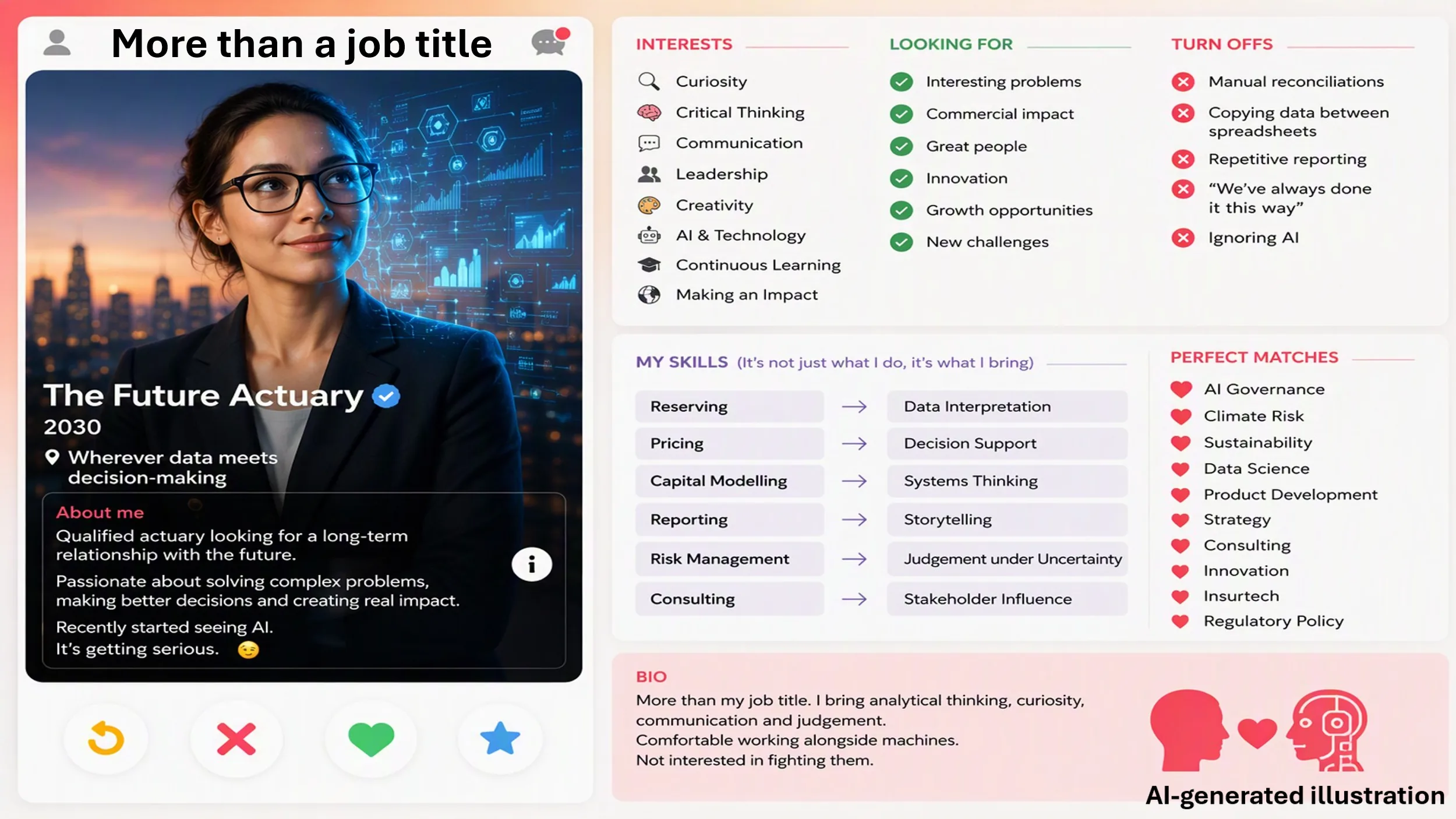
“Can you describe yourself without naming your job title or your software?”
Jenny Johnston BAFS, FIA, FSAI, Director, Acumen Resources
This is not an exercise in self-promotion. Every claim has to be backed by something you have genuinely done. It is about positioning. A CV largely records where you have been. Your professional positioning should also communicate where you could go next.
Are we hiring people, or clones?
Actuarial specialisation is valuable. But it can become limiting when we confuse our current label with our full potential.
From the candidate side, “I’ve spent 15 years in reserving, therefore I must stay in reserving” is understandable. It is also the career equivalent of deciding you can only date somebody who lives on your street.
Employers can fall into the same trap. Hiring decisions often gravitate towards familiar experience: the same job title, the same software and the same career path.
“Perhaps we are not dating clones. But sometimes we are trying to hire them.”
Jenny Johnston BAFS, FIA, FSAI, Director, Acumen Resources
If we genuinely want more adaptable actuarial careers, we need to become better at recognising transferable capability, not only identical experience.
The skills underneath actuarial work can create value in areas such as AI governance, model risk, climate and sustainability, analytics, product strategy, enterprise risk, investment, regulation, innovation and commercial decision-making.
A future career match may not look exactly like your current one. Perhaps that is the point.
The red flags we should pay attention to
Every dating profile has them. So does every career.
“We’ve always done it this way.”
Rigour, process and control are central to actuarial work. But they should not prevent us from asking whether there is now a better way.
“AI isn’t relevant to me.”
The 2026 survey found AI use across career stages. Even if AI does not replace a role, it may change the workflow, expectations, pace of delivery or skills that are valued.
“I can’t move because I’d have to take a pay cut.”
A secure job and a good salary are assets. They can also give you room to experiment while the stakes are relatively low: volunteer for an unfamiliar project, develop a new skill or broaden your exposure.
“I’m too senior to learn something new.”
Seniority should not be the point at which curiosity stops. Senior people also shape whether others feel permitted to experiment and learn.
“The model output must be right.”
Perhaps this is the most important one of all. The future actuary is not somebody who automatically trusts the machine. It is somebody who knows how to use it, question it and translate its output into decisions.
You don’t need a five-year plan
People often ask what they should actually do. I think the answer can be surprisingly small.
Careers rarely transform because of one giant decision. More often they change through repeated exposure to new ideas: one conversation, one experiment, one skill investment.
Rigour. Range. Relationships.
The future actuary is not less actuarial. Technical strength and professional judgement still matter. But I think the profile is becoming broader.
Together, they make actuarial expertise more strategically useful.
The future of the actuarial profession is not predetermined. AI will change the work, but we still have considerable influence over what our profession becomes.
“The future actuary does not win by competing with AI. The future actuary wins by combining actuarial judgement with AI capability.”
Jenny Johnston BAFS, FIA, FSAI, Director, Acumen Resources
So do not get ghosted by the future.
“Swipe right on curiosity. Swipe right on AI. Swipe right on what comes next.”
Jenny Johnston BAFS, FIA, FSAI, Director, Acumen Resources
Because, just like the best relationships, some of the best career opportunities start with a conversation.
What does this transformation look like in today’s Irish actuarial market? Explore our 2026 Actuarial Salary and Industry Insights for data on AI adoption, salaries, career progression, benefits and working patterns across the Irish actuarial profession.
Explore the surveyPart 2 of this series: AI and the Actuary: What Our 2026 Survey Tells Us About the Future of Actuarial Work looks at how actuaries are using AI, which tasks it is changing and what our salary data shows. The full survey results are in our actuarial salary guide.

Jenny is a Director at Acumen Resources and works across all actuarial practice areas, with candidates at every career stage. A certified career coach, she sees at first hand how the skills employers prioritise are changing. This article is adapted from her presentation at the Society of Actuaries in Ireland Annual Convention 2026.
Frequently Asked Questions
What skills will actuaries need in the future?
Technical strength and professional judgement still matter, but the profile is becoming broader. Jenny Johnston sums it up as rigour, range and relationships: technical credibility and the curiosity to keep learning, using technology as leverage while connecting analysis to the wider commercial decision, and communicating complexity with judgement, ethics and context.
What is the future of the actuarial profession?
The profession is not becoming less actuarial. AI is changing some of the tasks inside actuarial jobs, such as production work, documentation and first drafts, which moves more effort towards judgement, challenge, insight and decision-making. The future is not predetermined, and actuaries still have considerable influence over what the profession becomes.
Can actuaries move into areas outside traditional actuarial work?
Yes. The skills underneath actuarial work can create value in areas such as AI governance, model risk, climate and sustainability, analytics, product strategy, enterprise risk, investment, regulation and commercial decision-making. Employers also need to become better at recognising transferable capability, not only identical experience.
How should actuaries describe their skills on a CV?
Move beyond simply listing technical skills. Show how you’ve applied them and the impact you’ve had. Rather than writing “strong stakeholder management” or “experienced in financial modelling”, give the reader evidence: “Presented quarterly reserving results to senior stakeholders, explaining key movements and their financial impact.” A strong actuarial CV should bring together three things: technical capability, business understanding and communication. And increasingly, it should also demonstrate adaptability, data and technology skills, and how you’ve used tools such as automation or AI to work more effectively. The key question is: what can you do, where have you demonstrated it, and what difference did it make?
Start With a Conversation
Jenny Johnston and the Acumen Resources team are available for a confidential conversation about your skills, your career and the Irish actuarial market. There is no obligation, and nothing is shared without your agreement.